
Journal Article Wellnes
🍁 Autumn Changes the Rhythm of the Body: Understanding Seasonal Wellness in Chinese Tradition
🍂 Autumn Changes the Rhythm of the Body As temperatures begin to fall, daylight becomes shorter and the air feels drier, our daily routines naturally begin to change. We may sleep differently, seek more warmth and comfort, or experience greater fatigue or a feeling of dryness. In the traditional Chinese approach known as Yangsheng (养生) — the practice of caring for life and maintaining everyday balance — seasonal changes have an important place. The underlying idea is simple: Our bodies and daily habits naturally respond to changes in the environment around us. Autumn is therefore traditionally viewed as a period of transition, when it can be useful to gradually adjust our diet, daily rhythm and wellness habits.
Why Is Autumn Important in Traditional Chinese Wellness?
Traditional Chinese culture places great importance on the changing seasons.
Spring is traditionally associated with growth and renewal, summer with expansion and activity, autumn with gathering and slowing down, while winter is more closely associated with rest and preservation.
This does not mean that the human body functions in completely different ways during each season. Rather, it represents a traditional way of observing the relationship between the environment, daily habits and overall well-being.
As autumn arrives, nature gradually slows down.
Temperatures fall, daylight changes and outdoor activity may naturally become less intense.
Within the philosophy of Yangsheng, this period can therefore be an invitation to gradually return to a calmer and more regular rhythm.
Autumn and the Traditional Concept of Dryness
One of the characteristics traditionally associated with autumn in Traditional Chinese Medicine is “dryness,” or zao (燥).
Within this traditional framework, dryness is closely associated with the autumn season and may be used to describe everyday sensations such as a dry mouth, dry throat, drier skin or an increased desire to drink.
These concepts belong to the traditional theoretical framework of Chinese medicine and do not directly correspond to modern medical diagnoses.
The purpose of Yangsheng is therefore not to diagnose a condition based on these sensations, but rather to adapt everyday habits to seasonal changes.
Why Pay More Attention to Food in Autumn?
Food has an important place in traditional Chinese approaches to everyday wellness.
Rather than following exactly the same eating habits throughout the year, traditional Chinese culture encourages adapting food choices to the seasons.
During autumn, foods and preparations traditionally considered gentle, nourishing and appropriate for the season may become more prominent.
Warm soups, porridges, cooked foods and certain herbal infusions can naturally become part of an autumn routine.
The goal is not to follow a strict diet, but to pay greater attention to what we eat and gradually adapt our everyday habits as the seasons change.
Plants Traditionally Used in Autumn Wellness
Certain plants and ingredients have an important place in traditional Chinese wellness practices.
Ginseng
Ginseng is one of the best-known ingredients in traditional Chinese wellness.
It has traditionally been associated with vitality and supporting the body's energy.
Ginseng can be used in different traditional preparations, including herbal beverages and infusions.
However, ginseng is not suitable for everyone. Individual circumstances should be taken into account, particularly for people who take medication or have specific health conditions.
Sceau-de-Salomon odorant
Sceau-de-Salomon odorant (Polygonatum odoratum), traditionally known as Yu Zhu (玉竹) in Chinese, is associated in traditional Chinese practices with nourishing the body and supporting comfort during periods of dryness.
It is traditionally included in certain preparations during drier periods of the year.
Goji
Goji berries are now widely known far beyond China.
In traditional Chinese culture, goji has long been used both as a food ingredient and in various traditional wellness preparations.
Goji can be eaten on its own, added to an infusion or combined with other ingredients.
One of its advantages is that it can easily become part of a simple daily wellness routine.
Can an Herbal Infusion Be Part of an Autumn Wellness Routine?
In Chinese culture, drinking an herbal infusion is not necessarily about seeking a particular immediate effect.
The preparation itself can become a moment to slow down.
Heating the water, preparing the ingredients, waiting a few minutes and then drinking slowly can create a small moment of pause in the middle of a busy day.
This reflects an important aspect of Yangsheng: taking care of yourself does not necessarily mean adding another obligation to your routine.
Sometimes, it simply means slowing down, paying attention to your rhythm and developing positive everyday habits.
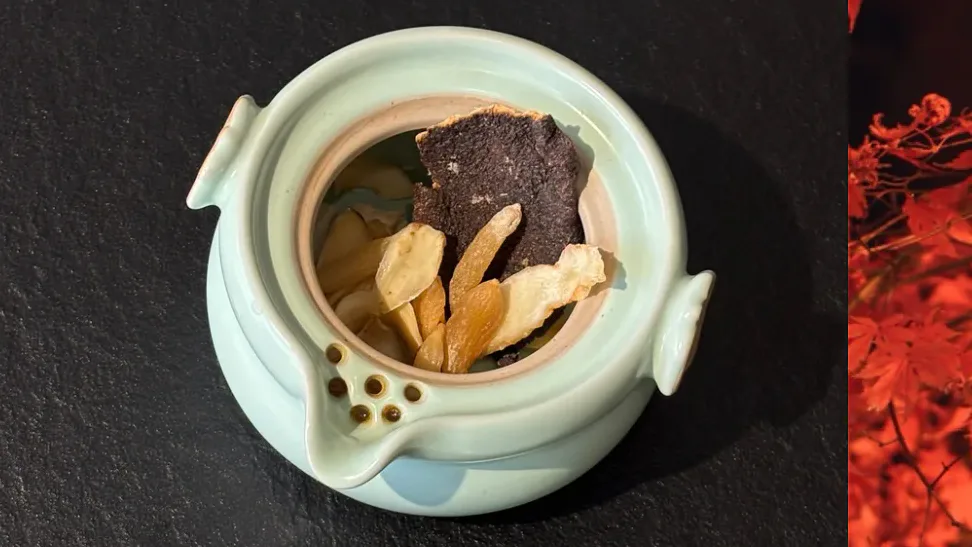
An infusion made with ginseng, sceau-de-Salomon odorant and goji can therefore be understood as part of the traditional Chinese culture of herbal beverages and seasonal wellness practices.
Autumn as an Invitation to Slow Down
One of the central ideas of Yangsheng is that well-being is not determined only by what we consume.
Sleep, food, movement, rest and emotional balance all form part of everyday lifestyle habits.
In autumn, this may simply mean:
returning to a regular sleep schedule;
choosing a varied diet adapted to the season;
staying adequately hydrated;
maintaining regular physical activity;
allowing more time for rest;
creating moments of calm during the day;
turning a warm drink into a personal moment of relaxation.
There is no need to completely transform your lifestyle.
Instead, the idea is to allow your everyday habits to gradually evolve with the seasons.
Autumn and Traditional Chinese Medicine: How Should We Understand It?
It is important to distinguish traditional Chinese concepts from modern medical knowledge.
Concepts such as dryness (zao), Qi, Yin and Yang, and the Five Organs belong to the traditional theoretical framework of Chinese medicine.
They should not simply be interpreted as modern medical diagnoses, conditions or physiological measurements.
Likewise, an ingredient traditionally used in Chinese culture should not automatically be considered to have a medically proven therapeutic effect or to be suitable for everyone.
“Natural” does not necessarily mean “risk-free.”
Pregnant or breastfeeding women, people who regularly take medication, or those with specific health conditions should seek professional medical advice before using certain herbs or concentrated herbal preparations.
A Seasonal Approach to Well-Being
The value of Yangsheng ultimately lies less in a particular plant or recipe than in a way of looking at everyday life.
Each season can be an opportunity to slow down, adjust our habits and become more attentive to our overall well-being.
Autumn reminds us of a simple idea:
Taking care of yourself can begin with small habits repeated every day.
A balanced diet, regular sleep, gentle movement, a few quiet minutes and a warm herbal drink can all become part of a personal wellness ritual.
Key Takeaways
🍂 Autumn is an important seasonal transition in traditional Chinese wellness.
Yangsheng encourages people to gradually adapt their lifestyle to the changing seasons.
During autumn, particular attention can be given to:
balanced nutrition;
adequate hydration;
sufficient rest;
regular sleep;
daily rhythm;
warm drinks and traditional herbal infusions.
Ginseng, sceau-de-Salomon odorant and goji are among the plants and ingredients traditionally used in Chinese wellness culture.
But the broader idea remains simple:
Follow the rhythm of the seasons and take care of yourself, one small habit at a time.
Please note: The concepts presented in this article belong to the traditional Chinese approach of Yangsheng and Traditional Chinese Medicine. They are provided for cultural and informational purposes only and do not constitute medical advice or replace a diagnosis, treatment or professional medical opinion.